Being a PC gaming aficianado since childhood, I was obsessed with 3D graphics cards when they came out, reading reviews of the latest ones and planning which ones I would get if only I had the money. The 1990s were a very different time for graphics cards than today since there were many manufacturers in the mix, with 3dfx being the market leader. Eventually, I started paying attention when positive reviews for cards based on a chipset known as the Riva TNT appeared from a new company called Nvidia.
When it finally came time to upgrade our passable Matrox m3d card, I got to decide between 3dfx’s Voodoo 3 and cards based on Nvidia’s Riva TNT 2, the highly reviewed 3rd successful product from the company. While the TNT 2 beat the Voodoo 3 on many metrics, I ended up going with the Voodoo 3, thinking it was the safe bet and still going to be the market leader (my experiences feeling burned by getting an AMD CPU instead of an Intel one likely played a part in this decision, too). I quickly came to realize my error as new games took advantage of the TNT 2’s features while several years later, 3dfx as a company was bankrupt, leading it to be acquired by…Nvidia.
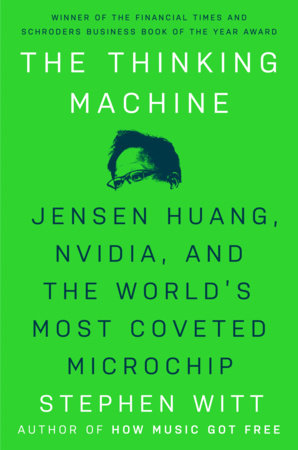
So I was pretty excited to read Stephen Witt’s book, which traces its founder Jensen Huang his early years to Nvidia’s founding to the company being the computing hardware leader powering the modern AI revolution.
Published around the same time as Karen Hao’s book focusing on OpenAI which I previously summarized, Witt’s book is comparatively a much breezier read and also less comprehensive and nuanced, but it’s nonetheless entertaining and provides many interesting nuggets. I summarize some highlights that I found most interesting here.
Huang’s first introduction to America was a poor boarding school in Appalachia Link to heading
I had read in a news profile several years ago that Huang had arrived from Taiwan as an elementary school child and enrolled at Oneida Baptist Institute. Given the name, I had always assumed his parents were religious and had enrolled him in a well-to-do Christian boarding school.
The book makes clear this was not the case. Oneida was instead a juveline-reform academy within Appalachian Kentucky, populated by children of tobacco farmers and other blue collar workers. As expected, this mean Huang dealt with lots of racism and bullying. But despite these challenges, the book says Huang thrived and was even a role model at the school, foreshadowing his later ability to adapt and thrive in new environments.
Nvidia’s first few product tried to win on innovative designs but was a flop Link to heading
After college, Huang moved to Silicon Valley. After his initial jobs as an electrical engineer at AMD and then at LSI Logic, a firm that developed the first software design tools for chip architects, Huang developed a reputation as a workhorse who could solve the thorniest technical challenges. His work at LSI also led to his being on a project with Sun Microsystems, a market leader that made high-end workstations. It was there he would meet his two Nvidia technical cofounders, Chris Malachowsky and Curtis Priem, and where Huang settled into a logistician/manager role. Their success releasing the Sun GX graphics processors in 1989 led to Huang getting the attention of LSI Logic’s founder, Wilf Corrigan, who promoted Huang to start a new division. Soon after, Priem and Malachowsky pitched Huang on starting a company together that made cheaper versions of the Sun GX graphics chip for the consumer market, Huang thoroughly evaluated the opportunity and risk before deciding yes, and Corrigan vouched for the team which enabled them to get their initial VC funding.
The New Venture (The acronym NV would eventually be used as the first two letters for Nvidia) focused on an innovative chip design focused on “quadratic texture mapping” in their inaugural NV1 chip. They believed this would differentiate the NV1 from other products. The problem was that this “differentiation” ended up being a con, since other than the one game built for it–Sega’s Virtua Figher–all other games preferred to render 3D objects using triangles rather than quadratic mapping.
Nvidia’s breakthrough product came due to its hail mary design process gamble Link to heading
With the NV1 being a massive failure, Nvidia had to start from scratch for its next product. This meant the next chip planned with that architecture would need to be scrapped. The problem was that Sega had promised to pay Nvidia $1M for the NV2 upon receipt of the prototypes. Huang amazingly convinced Sega to pay Nvidia the $1M despite saying they would not deliver the NV2 beyond the prototypes.
With little money left in the bank sans the $1M Sega money, Huang used it to buy an emulator. His gamble was that Nvidia, with little money and time left, would rely on emulation to design their next chip (the NV3) rather than use the typical cycle of manufacturing and testing physical prototypes. While this card was not innovative and mostly a “copycat chip” per the book, it was more powerful in some respects than other chips, such as supporting 2D and 3D graphics acceleration (at that time, 3D graphics cards were usually add-on cards just for 3D graphics; you still needed a 2D graphics card to do non-gaming things like render spreadsheets and word processors). The chip, branded the Riva 128, was successful, but most importantly revolutionized how quickly a graphics chip could go from design to production and changed the industry to use emulation.
Computer Graphics (and hence Nvidia) was considered a backwater Link to heading
I’m not sure if I fully agree about this, but the book claims that computer graphics for consumer applications such as gaming was considered a backwater, and so companies like Nvidia were looked down on for most of their history. It took the AI deep learning revolution to transform Nvidia into a household name revered by technologists.
While Huang foresaw the importance of parallel computing, modern AI was unexpected Link to heading
Nvidia first began using parallel computing in its chips when John Carmack, the legendary game engine designer famous for Doom and Quake, told Nvidia’s team that he wanted multiple to be able to run multiple “pixel shaders,” or algorithms that assigned colors to pixels in a 3D scene, at the same time. While competitors like 3dfx solved this by putting two graphics chips on the same card, Huang team promposed running parallel computations on a single chipset. While Huang was originally skeptical of this approach, being cognizant of all the dead parallel computing startups that came before, he eventually came around to it as he realized the need for this type of parallel computation would only increase over time, and it wasn’t practical to add more and more chips just to do this.
This later led to the development and release of CUDA in 2007, Nvidia’s parallel-computing library targeted at scientists. CUDA was Huang’s entry into what he termed “zero billion dollar markets,” which are markets that incumbents typically ignore to their peril based on business guru Clayton Christenson’s book The Innovator’s Dilemma. For a decade scientific computing made Nvidia no money, until deep learning appeared as the killer application for Nvidia GPUs. However, even Huang didn’t foresee this exactly; he only believed that there was some signal that there was going to be a market for scientific computing, but not to the scale AI created.
And of course, the book mentions crypto being a big booster of Nvidia profits from about 2017-2019, but Huang never expected this to be a long term market so Nvidia never publicized the use of their products for crypto mining (though they still happily took miners’ money).
Jensen Huang was almost ousted several times Link to heading
By the early 2010s, Nvidia’s stock had flatlined and many investors thought Huang was too distracted on side projects like CUDA, modems, and mobile devices rather than its core money-making markets. Activist investor Starboard Value took a small stake in Nvidia and began agitating for Nvidia to end projects like CUDA and pay dividends to shareholders. Other major shareholders like Fidelity were also actively skeptical of Huang’s leadership. At this point, there were rumors that major investors wanted to oust Huang as CEO.
However, Huang retained the support of his board, many of whom had been with the company since its early days, and was able to stay in power.
GPUs were never thrifty on power so AI’s energy use shouldn’t be surprising Link to heading
Towards the end of the book there’s a section about power use. Basically, GPUs have always been energy intensive to run, and in gaming rigs they are typically the most power hungry component. With GPUs now powering AI training and inference, and deep learning approaches needing so much GPU computation, the book emphasizes that this means user searches and chats now use a lot more energy than simple Google web searches of the past.
The book omits anything about AI applied to graphics Link to heading
As a computer graphics geek, I was disappointed that the book didn’t touch much on Nvidia’s AI advances towards graphics itself, which are pretty incredible. For example, using deep learning to games in real-time and perform physically accurate lighting in games (ray tracing). But I suppose these aren’t directly responsible for Nvidia’s rapid recent AI-related growth.
Intel tried to buy Nvidia, but Huang refused Link to heading
Intel attempted to buy Nvidia in 2005, but Huang was not in favor of the acquisition since that meant he would not remain CEO. In any case, Intel’s board ended up not supporting the offer.
Nvidia’s moat today is as much software as hardware Link to heading
The book concludes that Nvidia’s dominance today is as much software as hardware. Nvidia quickly writes libraries for new applications as they come along, and these domain-specific libraries for their proprietary CUDA software creates stickiness since users prefer using CUDA over even free open source options. (The exact reasons why aren’t detailed in the book.)